
Engineering a 3in1 building near the sea
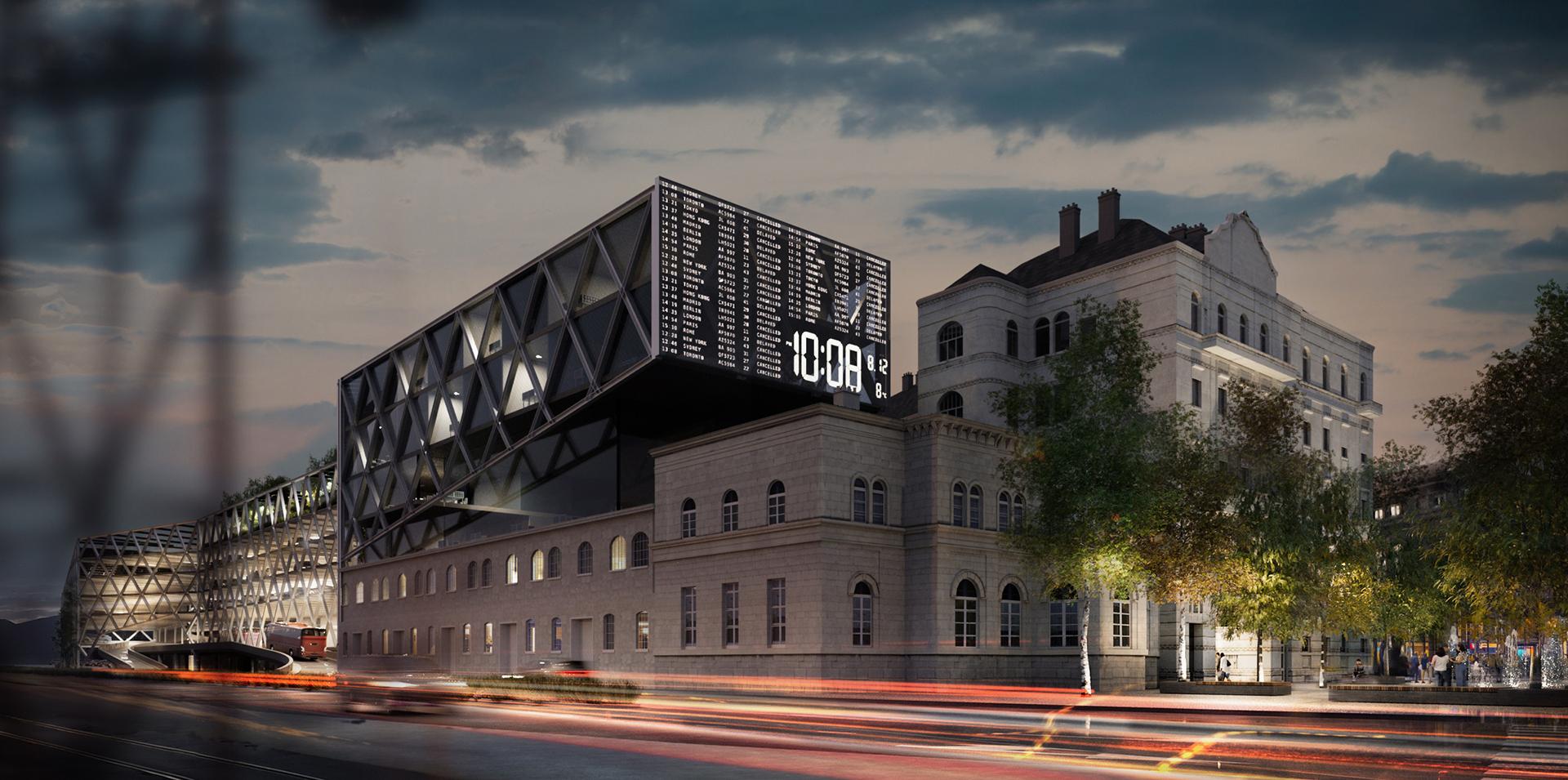
Building a 230-meter-long structure on former port land, where bedrock lies anywhere between 10 and 40 meters deep, is a task that goes far beyond just being bold and demanding. Add seismic loads, thermal movements across three separate structural units, and over 300 unique steel connections that need to work both structurally and aesthetically—and you begin to understand why the Žabica Bus Terminal in Rijeka represents one of the most technically demanding infrastructure projects in Croatia's recent history.
Foundation Engineering in Port Soils
Let's start right at the beginning: with the soil report.
The Žabica site lies in the port district of Rijeka, between the passenger port, shipping terminal, and railway station. It is a historically significant but technically difficult situation. Port warehouses constructed on fill dominated this area for a long time.
According to geotechnical studies, bedrock depths ranged from 10 to 40 meters. This meant that shallow foundations were never an option. The loads produced by a multi-level construction that included a bus terminal, an 800-space parking garage, and commercial spaces were simply too much for the fragile surface soils to bear.
363 Reinforced Concrete Sentinels
In order to transport building loads through the weak soil layers to adequate bearing strata below, the engineering team, under the direction of structural engineer Saša Mitrović from i.t.t. and Stabilnost, specified over 300 reinforced concrete piles.
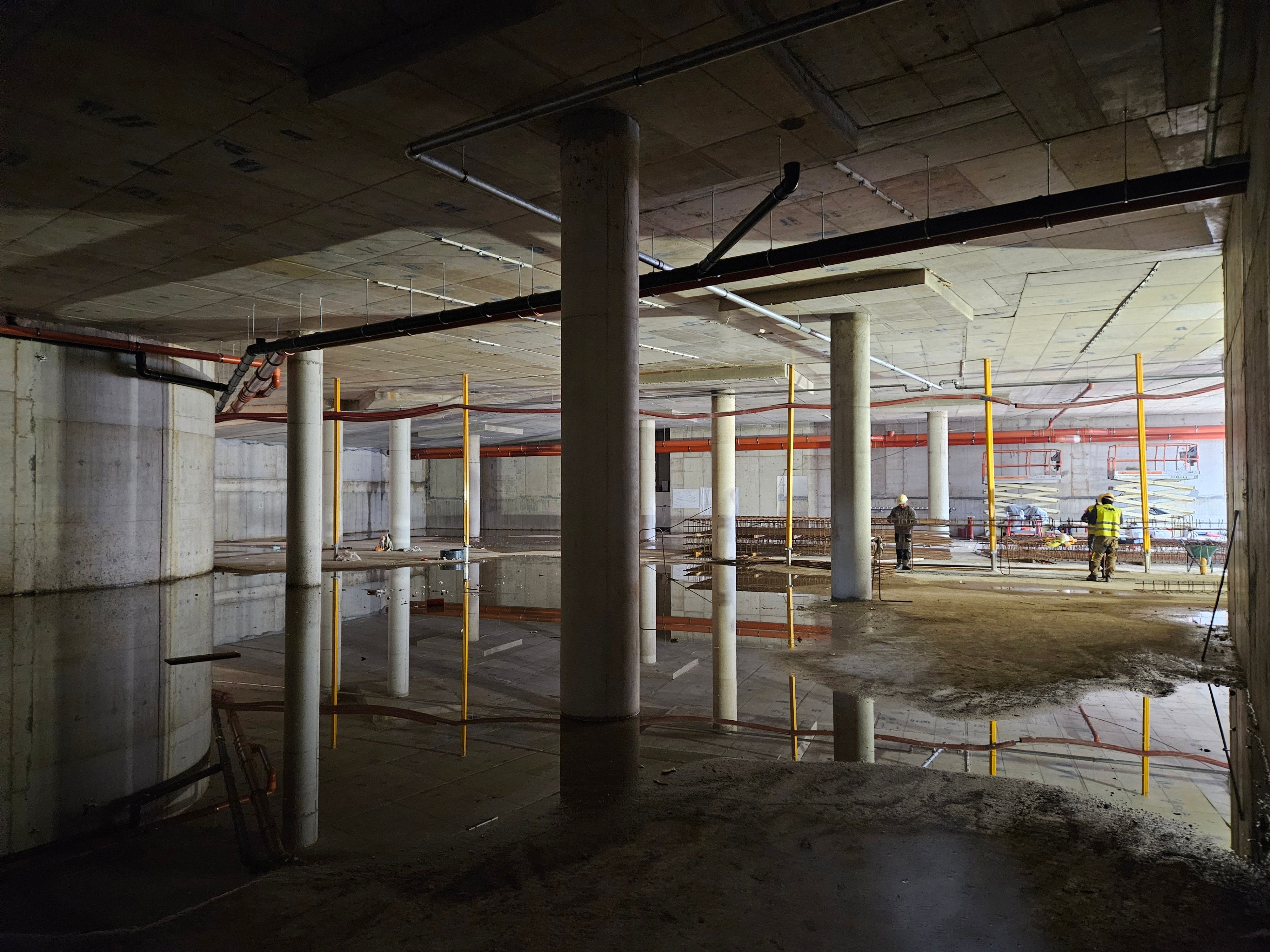
Because of debris, lateral movement, soil density, and old port infrastructure, pile installation poses special difficulties in maritime and port situations where soil conditions can change significantly over short distances.
Before the superstructure could start, each pile for Žabica had to be placed, driven or drilled, examined, and confirmed. This is the result of hundreds of hours of coordination between quality control inspectors, foundation contractors, and geotechnical experts. This work is mostly done underground and out of sight, but it has a significant impact on whether the building will stand or settle.
Thermal Expansion Strategy for 3in1 Building
The Žabica Terminal is not just one building. Through expansion joints, three distinct structural units are connected.
So why go to the trouble of dividing what appears to be a continuous structure? Well, for a 230-meter-long structure exposed to Croatia's coast climate, where temperatures can swing from winter lows around 0°C to summer highs exceeding 35°C, the potential thermal movement is significant - over 10 cm to be exact.
All that before even considering concrete elements, which have different expansion coefficients, or the added complexities of differential heating.
The Expansion Joint Solution
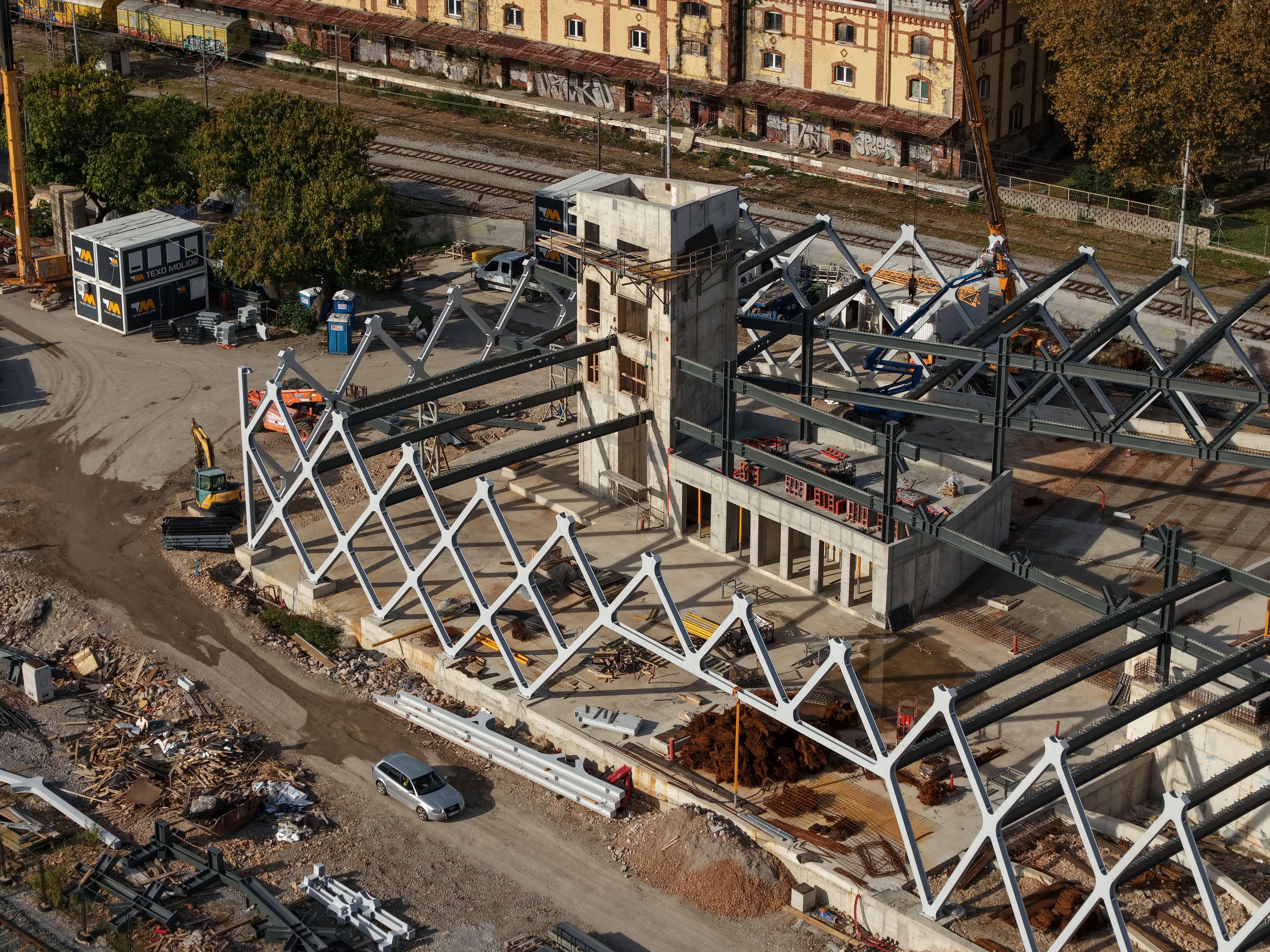
Rather than force the entire 230-meter structure to accommodate this movement as a single unit, which would generate enormous internal stresses at restraint points, the engineering team divided the building into three independent structural units.
At Žabica, portions of the existing warehouse walls at the location of Expansion Joint 3 were deliberately retained and integrated into the new design, requiring protection measures during both demolition and construction phases. Maintaining thermal independence between these structural units while keeping historical aspects created an additional layer of coordinating complexity.
The Diagrid Exoskeleton
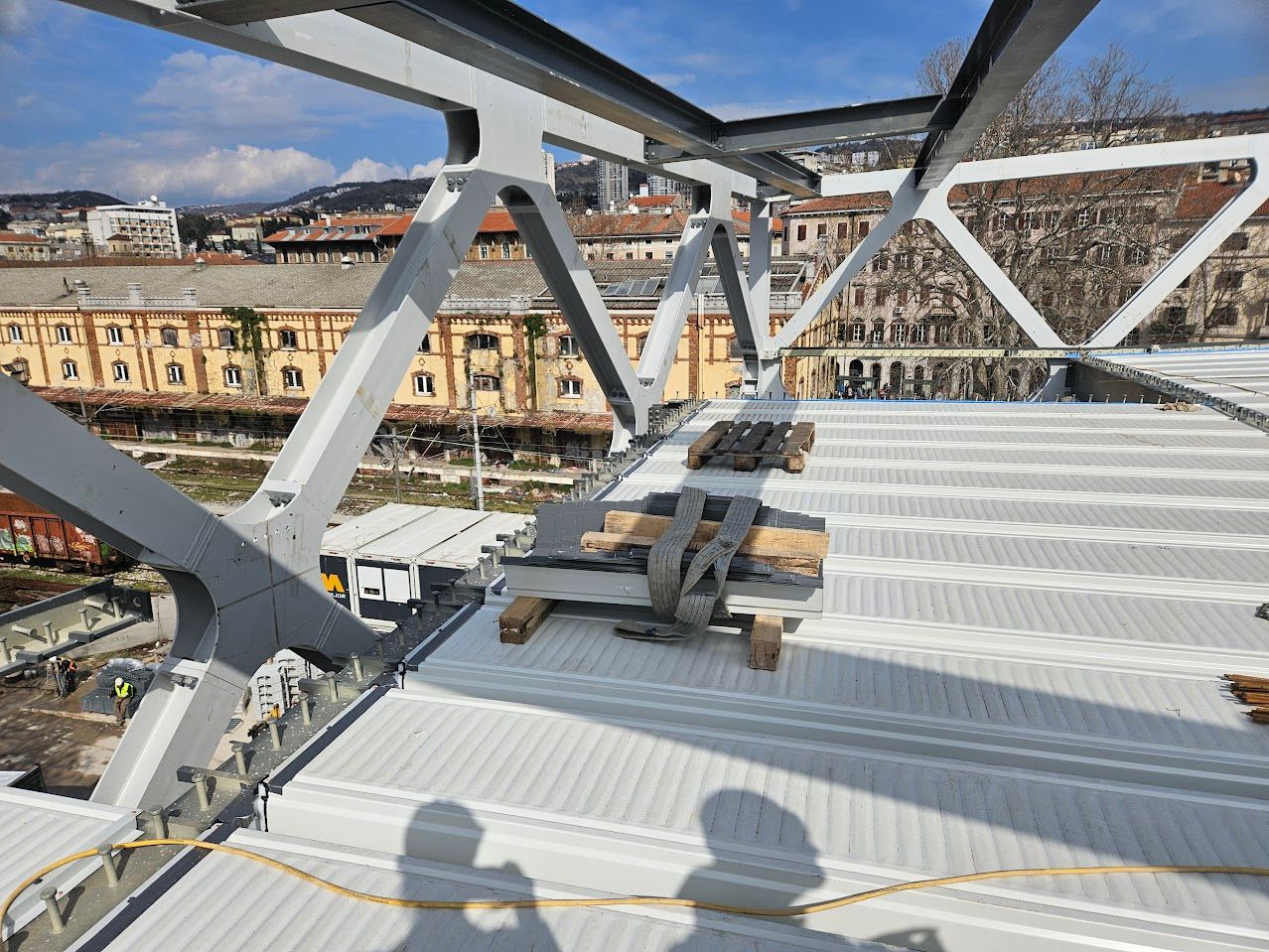
The “the” element that characterises this project is the geometric diagrid steel exoskeleton. Diagrids offer several performance benefits that make them particularly suited for challenging projects like this one:
1. Efficient lateral load resistance
2. Reduced shear deformation
3. Column-free interior spaces
4. Architectural expression
5. Seismic performance
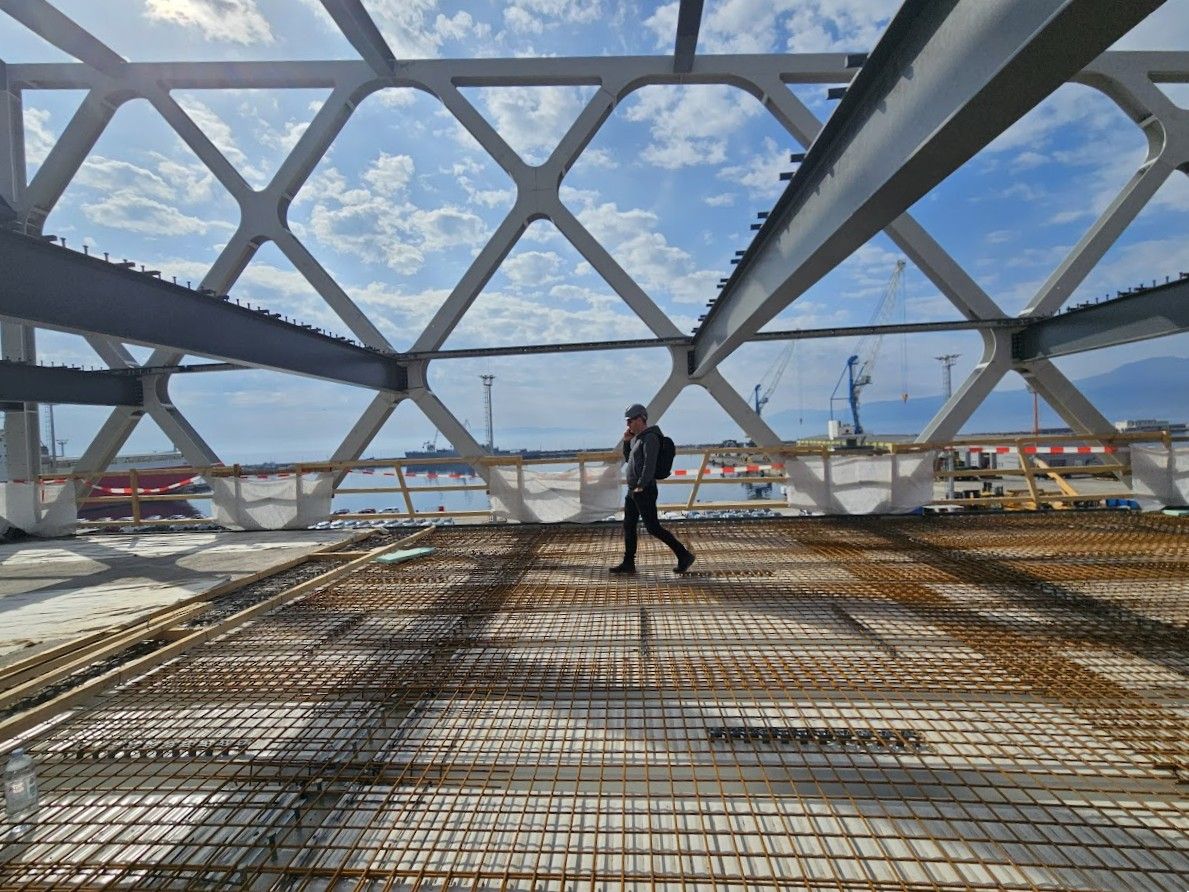
Diagrid systems can offer higher earthquake resistance in seismically active areas, such as Croatia, due to the triangulated geometry that naturally distributes forces and allows for regulated energy dissipation. Besides that, by locating the primary structural system on the building's exterior, diagrids eliminate or drastically reduce the need for internal columns. In this case, it creates column-free spans of up to 16 meters in the parking garage.
The Engineering Challenge
Here's where theory meets reality: every node in a diagrid is a custom steel connection. In contrast to typical architectures' repetitious beam-to-column connections, diagrid nodes require many components coming together at intricate angles. At Žabica, the structural team had to deal with:
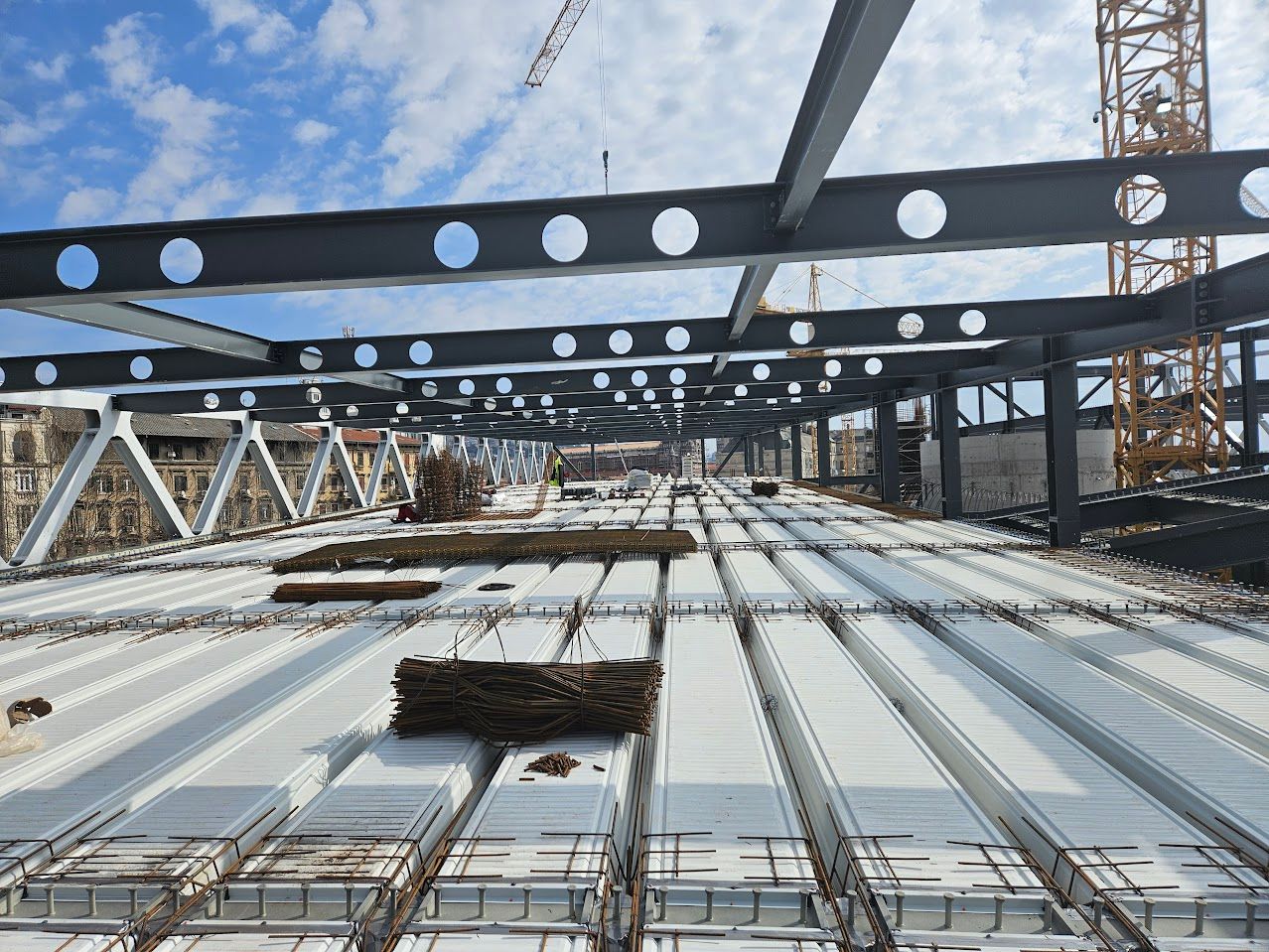
- Composite floor systems: Using endplate bolted connections, 16-meter-long IPE 550 girders were attached to the exoskeleton on one side and longitudinal HEA 550 beams on the other.
- Beam-to-column connections: HD 400×314 column sections are joined to longitudinal beams using a variety of connection techniques, including being stubs and bolted endplates.
- Diagrid-to-diagrid intersections: Diagonal members meeting at nodes, each requiring verification for multiple load combinations
- Foundation anchorage: Different types of steel column-to-concrete foundation connections, each analyzed for anchor bolt forces and base plate stresses
We talked with the lead structural designer, Saša Mitrović, who described the challenge:
“There are a total of 416 connections that were designed and detailed. This number includes all basic types and all variations that need to be worked out in detail. Diagrid connections sizing was governed by the ultimate limit state for standard and seismic combinations. All connections are designed to be stronger than the connected members (predominantly HEA300) to achieve the needed ductility in an extreme seismic scenario. Bus Terminal Žabica is one of the most complex projects we've undertaken so far, particularly because of the number of unique steel connections and complex structural details.”
The team used different specialized software like IDEA StatiCa for steel connection design, and VOLUM3, to have an overview of every stage at any moment with the whole documentation in one place.
Integrating Reinforced Concrete Cores with Steel Exoskeleton
The diagrid doesn't work alone. Each of the three structural units incorporates reinforced concrete cores that work in tandem with the steel exoskeleton to handle vertical and lateral loads, which creates a hybrid structural system.
The interaction between steel and concrete elements requires careful detailing between differential thermal expansion, construction sequencing, and connection detailing.
Coordinating Challenge
By now, a picture should be emerging of just how many interconnected pieces this project involves:
- 363+ foundation piles, each with installation records, load test data, and as-built coordinates
- Three separate structural units with expansion joint details at interfaces
- Hundreds of unique steel connections, each with calculations, shop drawings, and fabrication specifications
- Composite floor systems connecting steel beams to concrete slabs across 55,246 m² of floor area
- Architectural requirements that every structural element must satisfy (including aesthetic approval by 3LHD)
- Multiple contractors: Texo Molior and Karst as primary contractors, plus numerous subcontractors for specialized work (treba nadodati ostale ako ih ima)
- City officials and regulatory agencies require permits, inspections, and approvals at every phase
And every single one of these pieces generates documentation: drawings, specifications, calculations, meeting notes, inspection reports, RFIs, submittals, and change orders.
In traditional project delivery, this information lives everywhere and nowhere, from structural calculations in the engineer’s server to meeting notes in someone's old notebook. We won’t even mention all the revised drawings named "Zabica_Floor2_Rev7_FINAL_v3.dwg" circulating as email attachments.
The inevitable result: version control chaos. Someone working from an outdated drawing. A specification change that didn't reach the right subcontractor. An RFI response that got lost in an email thread. Delays while people hunt for information that exists somewhere.
For a project as complex as Žabica, these coordination failures aren't minor inconveniences. As a project manager, you must ask yourself: how do I prevent budget overruns and schedule delays?
VOLUM3 was specifically developed by an architectural studio to address this problem. As architects working on increasingly complex projects, they needed "a fast and effortless collaboration platform that simplifies the project process from start to finish".
VOLUM3 functions as a CDE. It’s a single, centralized repository where all project information lives. For a project like Žabica, this means that you can use:
- Digital plans: Latest structural drawings, instantly accessible to everyone who needs them
- Specifications management: Material specifications, product selections, and room-by-room finishes, all connected to tasks and schedules
- Task tracking: Creating, assigning, and monitoring thousands of individual tasks across disciplines
- Meeting documentation: Minutes that automatically link to drawings, specifications, and action items
- Change tracking: Complete audit trail of what changed, when, and why
- Multilingual support: International project teams accessing content in their preferred language
Completion and Legacy
As of October 2025, the Žabica Terminal construction continues toward its scheduled completion in mid-2026. The structure rising from the former port warehouses will serve as both a functional transportation hub and a new landmark redefining Rijeka's relationship with its waterfront.
But beyond the specific building, Žabica represents something larger: the increasing sophistication of both structural engineering and project coordination methods.
Sources:
https://www.ideastatica.com/case-studies/bus-terminal-zabica
https://www.rijeka.hr/radovi-na-izgradnji-kompleksa-zapadna-zabica-napreduju-prema-planu/
https://www.3lhd.com/hr/projekt/autobusni-terminal-zabica/