
Procore vs. VOLUM3
If you're searching for construction management software in 2025, you've probably encountered Procore, the industry giant that promises to revolutionize your construction projects. But before you commit to a potentially six-figure annual investment, it's worth exploring alternatives that might deliver better value for your specific needs. Architects, contractors, and project managers who desire robust capabilities without the intricacy and expense of enterprise-level solutions are increasingly turning to VOLUM3, a collaborative platform.
This comprehensive comparison breaks down the real differences between VOLUM3 and Procore, covering everything from pricing transparency to feature sets, so you can make an informed decision for your construction business.
Understanding the cost of Procore Construction Software
Let's talk about the elephant in the room: Procore pricing. One of the most frustrating aspects of evaluating Procore is the complete lack of pricing transparency. Unlike most modern software platforms, Procore doesn't publish standard pricing on its website, requiring every potential customer to go through a custom quote process.
How Procore Pricing Actually Works
Procore uses a volume-based pricing model calculated as a percentage of your annual construction volume (ACV). Industry sources report that this typically works out to approximately 0.1-0.3% of your total construction volume. While that might sound small as a percentage, the actual dollar amounts can be staggering:
- Small contractors ($5M-$20M annual volume): $4,500-$20,000 per year
- Mid-sized contractors ($50M-$250M annual volume): $50,000-$150,000 per year
- Large contractors ($250M+ annual volume): $100,000-$600,000+ per year
But the sticker price is just the beginning. Procore implementation costs can add substantial expenses:
- Small contractors ($5M-$20M revenue): ~$10,000 setup costs
- Mid-sized firms ($20M-$150M revenue): $20,000-$60,000 implementation
- Large enterprises: $100,000+ for comprehensive rollout with custom integrations
These implementation costs cover configuration, data migration, team training, and integration with existing systems like accounting software. And unlike some construction technology platforms, Procore doesn't offer a free plan or even a budget-friendly tier for smaller operations.
A Cost-Effective Procore Alternative
VOLUM3 takes a fundamentally different approach to construction collaboration software. As a Common Data Environment (CDE), VOLUM3 was built by architects who needed a fast and effortless collaboration platform that wouldn't require extensive training to use.
Transparent, Predictable Pricing
While VOLUM3 uses custom pricing based on your company's specific needs, the platform doesn't operate on the percentage-of-construction-volume model that makes Procore prohibitively expensive for many contractors. This pricing structure makes VOLUM3 particularly attractive to small and mid-sized construction companies, architecture firms, and specialty contractors who need robust collaboration tools without enterprise-level costs.
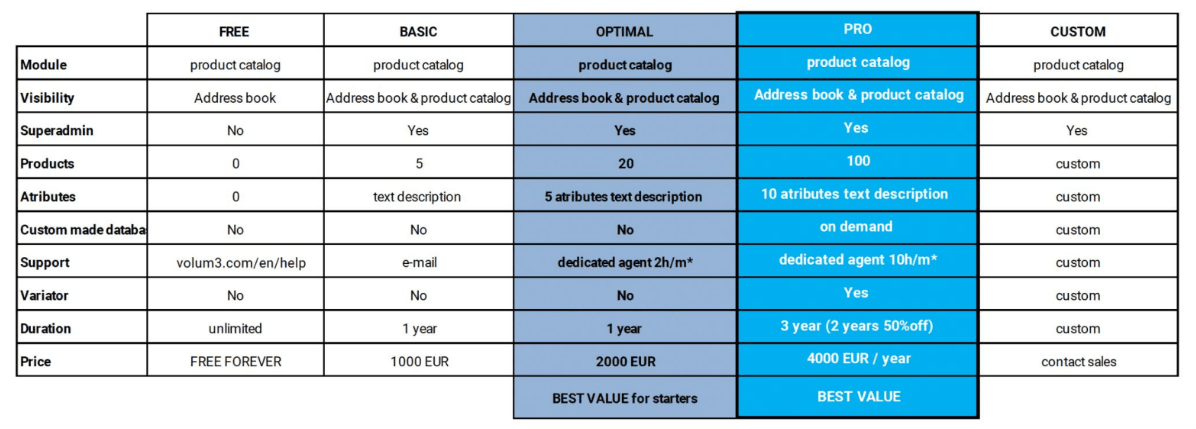
Architects are not required to pay any fee and can use VOLUM3 for free, while manufacturers can choose from one of five packages. There’s a free option, basic, optimal, pro, and custom package where you can choose the best values for your business. Check out pricing here:
What You Get with VOLUM3
VOLUM3 integrates all your project needs into one streamlined platform:
- Digital plans with automatic version control
- Task management and reporting with real-time updates
- Meeting minutes and follow-ups linked to project tasks
- Interactive specifications and schedules for material tracking
- Bill of Quantities (BoQ) with automated integration
- Multi-language support for international teams
- Unlimited cloud storage for project documents
- Room-level tracking for budget changes and material allocation
The platform is specifically designed for architects, interior designers, project managers, investors, facility managers, contractors, and manufacturers—essentially everyone involved in the construction process.
Feature-by-Feature Comparison: VOLUM3 vs Procore
Project Management and Collaboration
Procore excels at managing large-scale commercial construction projects with complex stakeholder requirements. Its project management capabilities include document control, RFI management, submittal workflows, and extensive permission controls. The platform supports unlimited users, which is beneficial for large teams, but the feature complexity can be overwhelming.
VOLUM3 focuses on making collaboration effortless across your entire team. The platform delivers: real-time collaboration, editing of specifications, transparent task tracking with clear due dates and responsibilities, automatic plan version control delivered to your team within seconds, customizable interactive schedules with filter and export capabilities, and direct product and material specification in one integrated workspace.
One key advantage: VOLUM3 was tested with large architecture companies who were "amazed by the fact that it allows them to very quickly ramp up their project and start using it". Subcontractors found it "extremely easy to use and learn", a stark contrast to Procore's steep learning curve. With VOLUM3, you also get free online education with the in-house team.
Document Management and Version Control
Both platforms offer robust document management, but with different philosophies.
Procore provides enterprise-grade document control with extensive audit trails, complex permission structures, and integration with BIM platforms. It's designed for projects with strict compliance requirements and multiple layers of review and approval.
VOLUM3 eliminates confusion over plan versions by automatically delivering the latest version to your entire team within seconds. The platform serves as your virtual showroom, keeping catalogs, product information, and project documents accessible at all times. For teams tired of hunting through email chains for the correct drawing revision, this streamlined approach is refreshing.
Financial Management and Cost Control
This is where the platforms diverge significantly.
Procore offers extensive financial management capabilities, including budget tracking, cost forecasting, change order management, contract administration, and integration with major accounting systems like Sage 300, QuickBooks, and Viewpoint. For large contractors managing complex budgets across multiple projects, these tools can justify the platform's high cost.
VOLUM3 integrates financial tracking more organically into the project workflow. The platform offers: automated Bill of Quantities (BoQ) created from specifications, room-level budget tracking with change management, material and product cost tracking linked to specifications, time tracking on tasks, and BoQ items, and work order creation and budget management.
Rather than requiring separate financial modules, VOLUM3 weaves cost tracking throughout the project lifecycle, making it accessible to everyone who needs it without extensive training.
Mobile Access and Field Productivity
Procore offers robust mobile applications for iOS and Android with offline capabilities. Field teams can create punch list items, manage RFIs, capture photos linked to drawings, track time, conduct inspections, and document incidents—all from their mobile devices. Over 2 million construction professionals use Procore's mobile apps globally.
VOLUM3 provides cloud-based access from any internet-connected device, enabling your team to access plans, files, tasks, and meeting information from anywhere, anytime. The platform's simple interface makes it easy for field teams to stay updated without requiring extensive training, and the multi-device support ensures everyone has access to current project information until the mobile app is available, which is predicted to be around April 2026.
BIM Integration and 3D Coordination
Procore supports Building Information Modeling through integrations with platforms like Autodesk Construction Cloud, Navisworks, and other BIM tools. For projects heavily reliant on 3D coordination and clash detection, Procore's BIM capabilities (often through partnerships) provide comprehensive support.
VOLUM3 approaches digital project management differently. Rather than focusing on complex BIM coordination, the platform emphasizes practical collaboration around plans, specifications, and documentation. This makes VOLUM3 more accessible to projects that need solid digital collaboration without the complexity of full BIM implementation.
The Procore Login Experience vs VOLUM3 Access
Getting your team into the system matters more than you might think.
Procore Login Process
Procore requires users to be invited by an administrator before they can access the system. Companies can enable Single Sign-On (SSO) or Multi-Factor Authentication (MFA) for enhanced security. While secure, this process can be cumbersome when bringing subcontractors or consultants onto projects quickly.
VOLUM3 Access
VOLUM3's cloud-based design prioritizes quick access for all team members. The platform's straightforward user management means less administrative overhead when adding collaborators. Since many subcontractors found VOLUM3 "extremely easy to use and learn", the onboarding friction is minimal—a critical advantage when you need consultants and trades to start collaborating immediately.
Who Should Choose Procore?
Despite its high cost and complexity, Procore remains the right choice for certain construction organizations:
Large General Contractors and Enterprise Firms
If you're managing $250 million+ in annual construction volume across multiple regions with complex compliance requirements, Procore's comprehensive feature set can justify the investment. The platform's unlimited user model, extensive integrations with ERP systems (SAP, Sage, Viewpoint), and advanced permission controls support enterprise-scale operations.
Projects Requiring Extensive Document Control
When your projects involve 20+ consultants, strict regulatory compliance, extensive submittal workflows, and detailed RFI tracking, Procore's robust documentation and audit trail capabilities shine. One construction professional managing a 240,000 sq. ft. mixed-use development with numerous consultants found Procore "indispensable for tracking the flood of submittals, RFIs, drawings, and emails.
Companies Already Using Procore-Integrated Tools
If your organization has already invested heavily in the Procore ecosystem and trained staff on its workflows, switching costs may outweigh the benefits of exploring alternatives.
Who Should Choose VOLUM3?
VOLUM3 represents a better value proposition for many construction professionals:
Small to Mid-Sized Contractors and Builders
If Procore's pricing—potentially 0.1-0.3% of your construction volume—feels disproportionate to your needs, VOLUM3 offers a compelling alternative. The platform delivers robust collaboration features without the enterprise pricing model that prices out smaller operations.
Architecture and Design Firms
Created by architects for architects, VOLUM3 understands the design-to-construction workflow. Large architecture companies were "amazed" at how quickly they could ramp up projects on the platform. The integrated specifications, material catalogs, and room-level tracking align perfectly with how design professionals actually work.
International and Multilingual Teams
VOLUM3's unique multilingual system allows content to be authored in multiple languages, enabling project collaborators to access data in their preferred language. This capability is virtually unmatched in the construction software space and invaluable for international projects.
Teams Prioritizing Quick Adoption
If you've experienced the frustration of lengthy software implementation timelines, VOLUM3's ease of use is refreshing. Subcontractors found it "extremely easy to use and learn", meaning less time training and more time building.
Projects Requiring Integrated Specifications and BoQ
For teams that need seamless integration between specifications, materials, quantities, and costs, VOLUM3's approach eliminates the manual rewriting and Excel juggling that plagues many projects. Specifications automatically integrate into the Bill of Quantities with dynamic filtering and analysis.
Real-World User Experiences
VOLUM3 users emphasize the platform's ease of adoption and practical functionality. Architecture companies appreciated how it allowed them to "very quickly ramp up their project and start using it for their project teams". Subcontractors were "interested in seeing VOLUM3 in action, finding it extremely easy to use and learn".
The platform enables even small companies to "compete with much larger firms by showcasing the quality of produced work directly from within the VOLUM3 Collaboration Platform", a competitive advantage that extends beyond simple document storage.
Making the Decision: Key Questions to Ask
Before committing to either platform, consider these critical questions:
1. What's your actual annual construction volume?
If you're managing less than $50 million annually, Procore's percentage-based pricing may be disproportionately expensive. Calculate what 0.1-0.3% of your volume would cost, then compare that to VOLUM3's pricing.
2. How complex are your compliance requirements?
Projects with extensive regulatory oversight, detailed submittal workflows, and strict audit trails may benefit from Procore's robust documentation. If your projects have more straightforward compliance needs, VOLUM3's streamlined approach may be preferable.
3. How quickly do you need teams to be productive?
Procore's learning curve is well-documented. If you need subcontractors and consultants collaborating quickly without extensive training, VOLUM3's ease of use is a significant advantage.
4. Do you work with international teams?
VOLUM3's multilingual content system is unique in the market. If your projects involve teams working in different languages, this feature alone could be decisive.
5. What's your implementation timeline?
Procore implementations can take months and require substantial dedicated resources. VOLUM3's quick ramp-up means faster time to value.
6. Are you primarily managing design or construction?
Architecture and design firms may find VOLUM3's approach,created by architects for architects, more aligned with their workflows. General contractors on large commercial projects might prefer Procore's construction-specific features.